
Biotechnology investors understand risk. They evaluate scientific hypotheses, clinical trial design, regulatory pathways, manufacturing requirements, competitive pipelines, and the capital necessary to advance a drug toward FDA approval.
Yet one critical question is frequently given insufficient attention during early development:
If the drug works and receives regulatory approval, will physicians prescribe it, will payers reimburse it, and will the resulting asset generate enough value to justify the investment?
After 36 years commercializing specialty and rare-disease therapeutics, including more than 20 product launches and leading three nationally #1 launch teams, I have seen firsthand how these questions influence commercial results.
More importantly, I have seen how decisions made years before approval can determine whether a company creates a valuable asset or simply advances an expensive development program.
The Traditional Biotech Value Model
The traditional biotechnology investment model is built around reducing scientific and regulatory uncertainty.
A promising discovery attracts initial investment. Preclinical research establishes the foundation for human studies. Phase I evaluates safety, Phase II begins to establish efficacy, and Phase III may provide the evidence necessary for regulatory approval.
As development milestones are achieved, investors may assign increasing value to the asset.
This approach makes sense. However, it can create a dangerous assumption: successful clinical development will naturally produce a commercially valuable product.
Clinical success and commercial success are not the same thing.
An FDA-approved drug can still struggle commercially because its benefits are insufficiently differentiated, physicians see little reason to change established treatment practices, or payers restrict access.
These risks do not suddenly appear at launch. Many originate during development.
The Commercial Value Gap
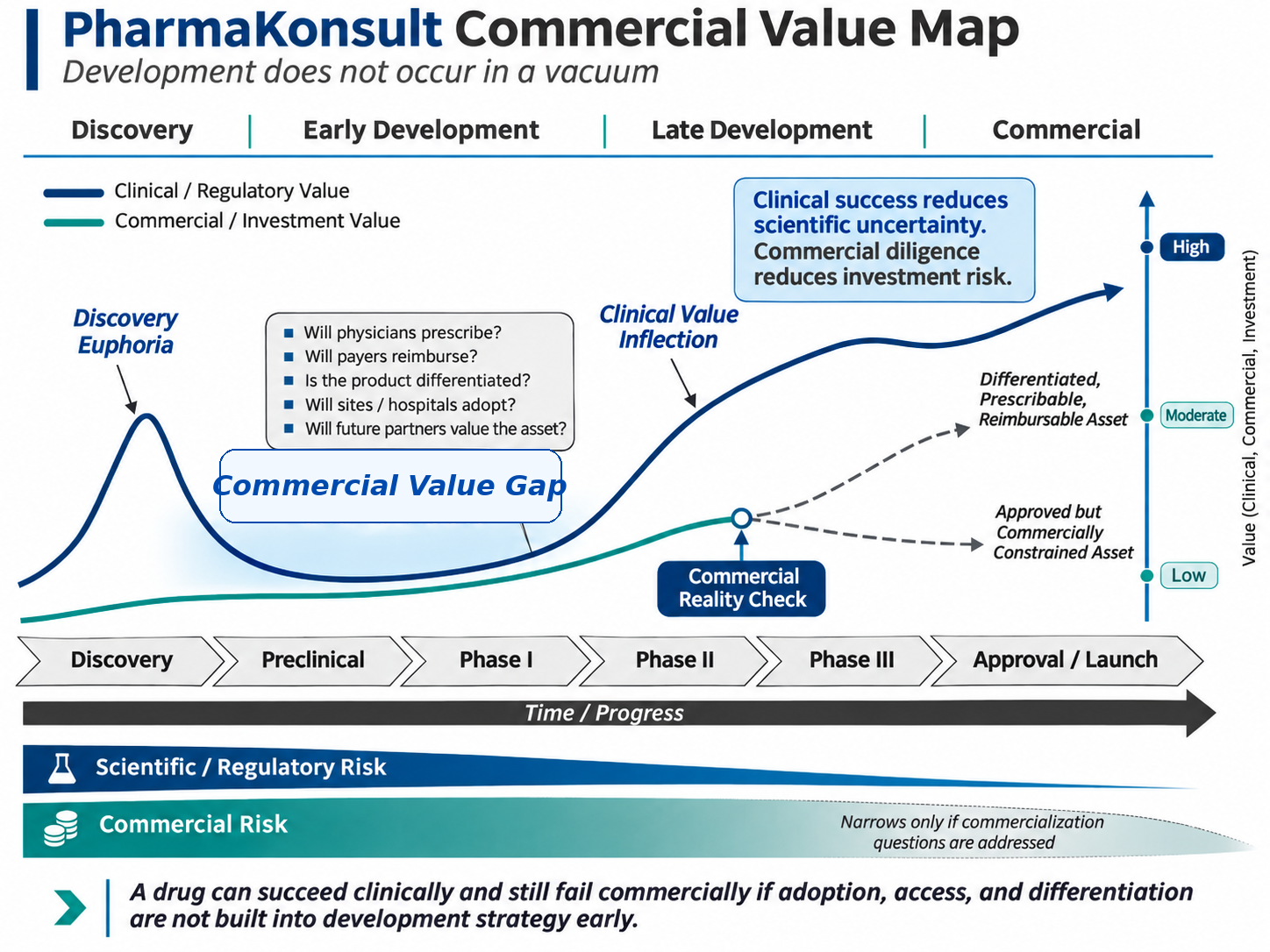
The biotechnology industry often refers to the financing difficulties between scientific discovery and commercial viability as the Valley of Death. I describe a related problem as the Commercial Value Gap.
A promising discovery can generate considerable enthusiasm. Capital is raised, development plans are established, and the organization begins working toward its next clinical milestone.
But beneath the scientific progress lies another set of questions.
What will the treatment landscape look like when the product reaches the market? What evidence will persuade physicians to change prescribing behavior? Will the product offer benefits that justify its price? Will hospitals and specialty treatment centers be prepared to adopt it? What will a future pharmaceutical partner consider commercially valuable?
When these questions are deferred, development spending can continue without a clear understanding of the asset's future commercial position.
The company may successfully cross its next clinical milestone while remaining at the bottom of a very different value curve.
Two Forms of Risk That Do Not Decline Together
The PharmaKonsult Commercial Value Map illustrates the distinction between scientific and regulatory risk and commercial risk.
Scientific and regulatory risks can decline as a development program generates stronger evidence. Commercial risk behaves differently. It may remain substantial even as a company approaches approval.
Consider a hypothetical specialty therapy entering Phase II. The molecule demonstrates encouraging efficacy and a manageable safety profile. Investors respond favorably, and the company prepares to finance a larger trial.
But the development program has not adequately established how the therapy will compare with future competing products. The proposed clinical endpoints may support regulatory approval without demonstrating the outcomes most important to prescribing physicians. The company may also be assuming a reimbursement pathway that does not reflect the treatment's likely position in clinical practice.
In this situation, additional clinical spending can reduce uncertainty about whether the drug works without adequately reducing uncertainty about whether the drug will succeed commercially.
Clinical progress can reduce scientific uncertainty without adequately reducing investment risk.
Why Conventional Commercial Analysis May Not Be Enough
Biotechnology companies have access to experienced executives, financial advisers, market research organizations, and management consulting firms. These resources can provide market forecasts, competitive assessments, valuation models, pricing research, and strategic recommendations. Many companies also conduct substantial commercial analysis internally.
The question is not whether these capabilities exist.
The question is whether the development plan has been challenged by someone with firsthand experience of what actually determines physician adoption, payer coverage, hospital access, and commercial performance.
A financial model may project substantial revenue. A market assessment may identify thousands of eligible patients. A clinical-development plan may demonstrate a credible path to regulatory approval.
Each analysis can be technically sound while still depending on assumptions that prove difficult to achieve in clinical practice.
Physicians may resist changing established treatment practices. Payers may restrict coverage. Hospitals may encounter operational barriers. Competing therapies may offer advantages that were underestimated during development.
These are not simply problems to be addressed by a sales force. They are potential threats to investment value that should influence the development plan years earlier.
I have spent 36 years working directly with these commercial realities across specialty pharmaceuticals, rare disease, and neuroscience. My experience includes more than 20 product launches, leadership of five nationally #1 teams, and repeated responsibility for building organizations that delivered measurable commercial results.
I am not simply evaluating what a product might earn in a financial model. I am evaluating whether the assumptions supporting that model are credible when confronted with actual physician, payer, hospital, and competitive behavior.
This perspective complements scientific, clinical, regulatory, and financial expertise.
Commercial Success Begins Long Before a Sales Force
Commercial success is often associated with product launch, sales-force deployment, and revenue generation. For an emerging biotechnology company, however, commercial success may occur much earlier.
It may involve creating enough differentiated evidence to attract a licensing partner, securing a favorable development partnership, strengthening the asset's valuation before financing, or demonstrating that continued investment is justified.
A biotechnology company does not necessarily need to launch its own product to create substantial value.
It needs to develop an asset that another company or investor sees a compelling reason to acquire, license, or finance.
A positive Phase II result may increase an asset's scientific credibility. But does it create meaningful competitive differentiation? Does it strengthen the product's future prescribing position? Does it improve the likelihood of payer coverage? Will a pharmaceutical partner see sufficient potential value to justify the licensing terms the company expects?
These questions are closely connected to capital allocation and the future financial value of the asset.
The Commercial Reality Check Should Come Earlier
Commercial evaluation should influence development strategy long before a company begins preparing for launch.
That does not mean attempting to predict every market condition five or ten years in advance. Such precision would be unrealistic. It means identifying the most consequential assumptions underlying future commercial value—and determining how development decisions can test them.
The selection of patient populations, clinical endpoints, comparator therapies, investigators, treatment settings, and evidence-generation priorities can influence the eventual product profile.
The choice of one development pathway over another can affect both the probability of approval and the commercial attractiveness of the resulting asset.
This is particularly important in rare diseases and specialty neurology, where treatment-center access, physician experience, limited patient populations, and reimbursement complexity can strongly influence adoption.
The question is whether the development program is producing the evidence needed to create a differentiated, prescribable, accessible, reimbursable, and ultimately valuable asset.
From Commercial Assessment to a Compelling Investment Story
At biotechnology conferences, I frequently encounter emerging companies with promising science, experienced researchers, and ambitious development plans. Many are seeking substantial investment to advance their programs.
Yet an important element is sometimes missing from their presentations.
They explain what the next round of financing will fund, but not always how that investment will create a more valuable asset.
A company may raise millions of dollars to advance its molecule into the next phase of development. But unless that investment produces evidence that strengthens commercial differentiation, future licensing attractiveness, or investment value, the company may find itself seeking additional capital without a substantially stronger investment proposition.
Capital can be consumed quickly. The question is whether that spending creates enough incremental value to justify the next investment.
Investors need more than the scientific rationale and the next clinical milestone. They need a credible explanation of how the development strategy will strengthen differentiation, support eventual physician adoption and reimbursement, and position the asset for licensing, acquisition, or further investment.
Through PharmaKonsult, I help biotechnology companies address this challenge in two connected ways.
First, I evaluate the commercial assumptions underlying the development program. Drawing on firsthand commercialization experience, I assess whether the planned evidence and product positioning can support a commercially differentiated and financially attractive asset.
Second, I help translate that assessment into a credible, evidence-based investment story. The objective is not simply to improve the appearance of an investor presentation. It is to explain why the asset deserves additional investment, what the next financing will accomplish, and how the resulting development milestones could strengthen its future financial and licensing value.
A credible investment story must answer three questions:
- What is the asset's commercial potential? Does the product offer a meaningful advantage in the treatment landscape it will eventually enter?
- How will development spending create value? Will planned milestones generate evidence that supports differentiation and future licensing opportunities?
- Why should investors commit capital now? What will the next investment accomplish, and how might that progress strengthen the asset's financial value?
A strong investment presentation should do more than explain why a molecule deserves to be developed. It should explain why the resulting asset deserves to be financed.
How PharmaKonsult Helps Protect Investment and Licensing Value
Through PharmaKonsult, I apply 36 years of firsthand commercial experience to biotechnology development and investment decisions.
I work with CEOs, boards, and investors to evaluate clinical-stage assets by working backward from the requirements for physician adoption, payer reimbursement, competitive differentiation, and future licensing value.
My independent, fee-based services include:
Commercial & Asset Value Assessment
An evaluation of whether the development strategy is building an asset with credible commercial potential and future financial value. This can include development priorities, differentiation, clinical evidence requirements, physician and hospital adoption, payer access, licensing attractiveness, and capital-allocation implications.
Investor Readiness & Investment Story Development
An assessment of the company's investment proposition, followed by development of a commercially grounded narrative connecting planned development spending to milestones that could increase asset value. This work helps leadership communicate the commercial rationale for additional investment, potential licensing opportunities, and the strategic importance of its development decisions.
Approval Is Not the Final Measure of Investment Value
A biotechnology company can execute clinical development successfully and still fail to generate the commercial results originally anticipated. That does not diminish the importance of scientific achievement.
It means scientific progress and investment value must be evaluated through different, but connected, perspectives.
The companies that recognize this distinction early have an opportunity to make better-informed decisions about capital allocation, evidence generation, competitive positioning, and future partnerships.
The objective is not to eliminate risk. That is impossible in drug development. It is to identify preventable commercial weaknesses before substantial capital has been committed.
Drug development does not occur in a vacuum.
The marketplace is not something a biotechnology company encounters for the first time after FDA approval. It should influence development decisions from the beginning.
About PharmaKonsult
PharmaKonsult provides independent, fee-based Commercial & Asset Value Assessments and Investor Readiness & Investment Story Development for biotechnology companies, investors, and boards.
Drawing on 36 years of firsthand specialty pharmaceutical commercialization, more than 20 product launches, and leadership of five nationally #1 teams, Joseph McCoy evaluates how development decisions influence physician adoption, payer reimbursement, competitive differentiation, licensing opportunities, and investment value.
If your organization is approaching a significant development, financing, or licensing decision, contact PharmaKonsult to discuss a confidential commercial assessment and investment strategy engagement.
PharmaKonsult.com · Contact PharmaKonsult · Investment & Asset Value Creation Assessment
Graphic note: The PharmaKonsult Commercial Value Map is a conceptual illustration of development-stage scientific, commercial, and investment risks—not a historical valuation model or financial forecast.